Chronic back pain is the most common reason people come to see me. More than posture concerns, more than athletic performance, more than any other single complaint. And almost everyone who walks in has the same story: they’ve tried things that helped for a while, then the pain came back. Physio, massage, chiropractic, medications. Some relief, but never a real resolution.
I think the reason most treatments don’t stick is that they’re focused on the wrong thing. They treat the back. Rolfing treats the body that the back is attached to. That distinction matters more than it might sound, and I want to explain why, including what the research actually says about Rolfing and chronic back pain.
Why back pain becomes chronic
Conventional thinking has limits
The standard approach to back pain focuses on where it hurts. Your lower back is painful, so we look at your lower back. Maybe we find a herniated disc or some degenerative changes on imaging. Problem identified, right?
Not necessarily. Decades of research have shown that structural findings on imaging often don’t match up with pain. A well-known study in the New England Journal of Medicine found disc abnormalities on MRI in 64% of adults who had no back pain at all. Meanwhile, plenty of people with severe pain have clean-looking scans.
That doesn’t make structural findings irrelevant. But it tells us the picture is more complicated than one damaged structure. Something else is contributing.
Your back pain probably isn’t a back problem
This is the core of how Rolfing thinks about chronic pain: the back is where the problem shows up, but it’s rarely where the problem starts.
Here’s an example I see all the time. Someone sprained their ankle years ago. It healed, but never regained full range of motion. The knee on that side started rotating slightly inward to compensate. That shifted the pelvis. The pelvis changed the lumbar curve. And now, years later, the back hurts. Nothing is wrong with the back itself. It’s just absorbing the cost of a compensation chain that started at the ankle.
This isn’t hypothetical. I see patterns like this regularly in my Toronto practice. The body is good at compensating for injuries and restrictions, but those compensations aren’t free. The tissues forced to take on extra load eventually start to protest. And because the back is the central structural hub of the body, it’s where protests tend to land.
Sedentary life makes it worse
Modern life is hard on backs. Prolonged sitting, whether at a desk, in a car, or on a couch, creates a specific set of fascial adaptations: shortened hip flexors, weakened glutes, a compressed lumbar spine, a forward-tilting pelvis. These aren’t temporary muscle issues. Over time, the fascial web locks into these positions, holding the body in patterns that stress the back continuously.
For people in Toronto who commute, sit at work all day, then sit again in the evening, these patterns are almost universal. The body doesn’t care whether you’re sitting at a Bay Street office or a Roncesvalles cafe. It adapts to whatever position you hold most often.
How fascia contributes to back pain
Fascia generates pain directly
For a long time, medicine treated fascia as inert packing material. That’s changed. We now know fascia is densely packed with sensory nerve endings, including pain receptors. The thoracolumbar fascia, the broad sheet of connective tissue covering the lower back, actually contains more pain receptors than the muscles underneath it.
So when fascia becomes thickened, dehydrated, or stuck together (from injury, inflammation, disuse, or chronic postural stress), it can be a pain source on its own, separate from any muscle or joint issue.
Fascia transmits force across the body
Fascia also transmits mechanical forces throughout your body. A restriction in the hip fascia can change how forces load through the lumbar spine, creating stress patterns that produce pain. This is why treating only the painful area so often fails with chronic back pain. The pain is in the back, but the fascial restrictions driving it may be in the hips, legs, or abdomen.
Fascia shapes your posture
Your posture isn’t primarily held by muscles. It’s shaped by your fascial network, which determines how your bones sit, how your joints align, and how your weight distributes through your body. When fascial patterns get distorted through injury or habitual positioning, posture changes. Those postural changes place uneven loads on spinal structures, leading to disc problems, facet joint irritation, and muscle spasm.
Rolfing works directly with these patterns. By releasing restrictions and reorganizing the fascial web, we change the conditions creating the pain. For more on this approach, see our why Rolfing page.
How I work with chronic back pain
When someone comes to me with back pain, the assessment reflects everything above. We don’t just look at the back.
Assessment
The first step is understanding your body’s structural story. I’ll observe you standing from the front, back, and sides, noting weight distribution, pelvic orientation, spinal curves, and head position relative to ribcage and pelvis. Then I’ll watch you walk, bend, and breathe, because how you move reveals restrictions that standing still won’t show. Your injury history, work habits, activity patterns, and surgical history round out the picture.
This often turns up patterns people had no idea about. One hip significantly higher than the other, a ribcage rotated relative to the pelvis, breath restricted on one side. These patterns are the structural context for the back pain.
Treatment
Based on what I find, treatment addresses the whole body. A course of Rolfing for back pain might include:
- Freeing the breath. Restricted breathing shows up in almost every chronic back pain case. Tension in the diaphragm, ribcage, and abdominal fascia limits spinal movement and strains the lower back. Opening the breath is often one of the first things I address, and one of the most effective.
- Releasing the hips and legs. Restrictions in hip flexors, hamstrings, the IT band, and lower leg fascia all affect pelvic position, and the pelvis directly determines lumbar curve and loading. Many clients are surprised that the biggest relief for their back comes from work on their legs.
- Working with the pelvic floor and deep core. These muscles and fascia are important for spinal stability. Rolfing restores balance between the front and back of the body at this level.
- Addressing the thoracolumbar fascia directly. When this broad sheet of connective tissue becomes thickened or adhered, it can generate pain on its own. Careful manual work restores its mobility.
- Organizing from the ground up. Restrictions in feet and ankles affect everything above them. Rolfing’s systematic approach includes the foundation your whole body stands on.
- Integrating the upper body. Shoulder and neck tension affects how the spine is organized overall. A shoulder girdle pulled forward shifts your center of gravity and increases load on the lower back.
This work is organized through the Ten Series, which addresses all layers and regions of the body systematically.
What the research shows
Rolfing hasn’t been studied as extensively as some conventional therapies, but the existing research is encouraging for chronic pain.
A study by Cottingham and colleagues in the Journal of the American Osteopathic Association found that Rolfing produced measurable changes in pelvic tilt and significantly reduced chronic low back pain. The structural changes held over time. Deutsch and colleagues, publishing in the Journal of Bodywork and Movement Therapies, found statistically significant improvements in pain levels, functional ability, and well-being in chronic pain patients who received Rolfing.
On the mechanism side, Robert Schleip, PhD (a leading fascia researcher who is also a Certified Rolfer) has demonstrated that sustained manual pressure, the kind used in Rolfing, produces measurable changes in fascial tissue: water content, fiber organization, and neural signaling all shift. This gives us a plausible biological explanation for what we see clinically.
A pilot study on Rolfing for chronic low back pain found significant reductions in disability scores (measured by the Oswestry Disability Index) after a series of sessions, with improvements maintained at follow-up.
Being honest about the evidence
I want to be straightforward. Rolfing isn’t a cure for all back pain. The research base is positive but still small compared to more established therapies, and large-scale randomized controlled trials are limited.
What the evidence does support is that Rolfing produces real, measurable structural changes, that those changes correlate with meaningful pain reduction, and that improvements tend to last. That matches what I see in practice. Most clients with chronic back pain improve significantly through a course of Rolfing. Not all, but most.
What to expect at a session
Your first visit
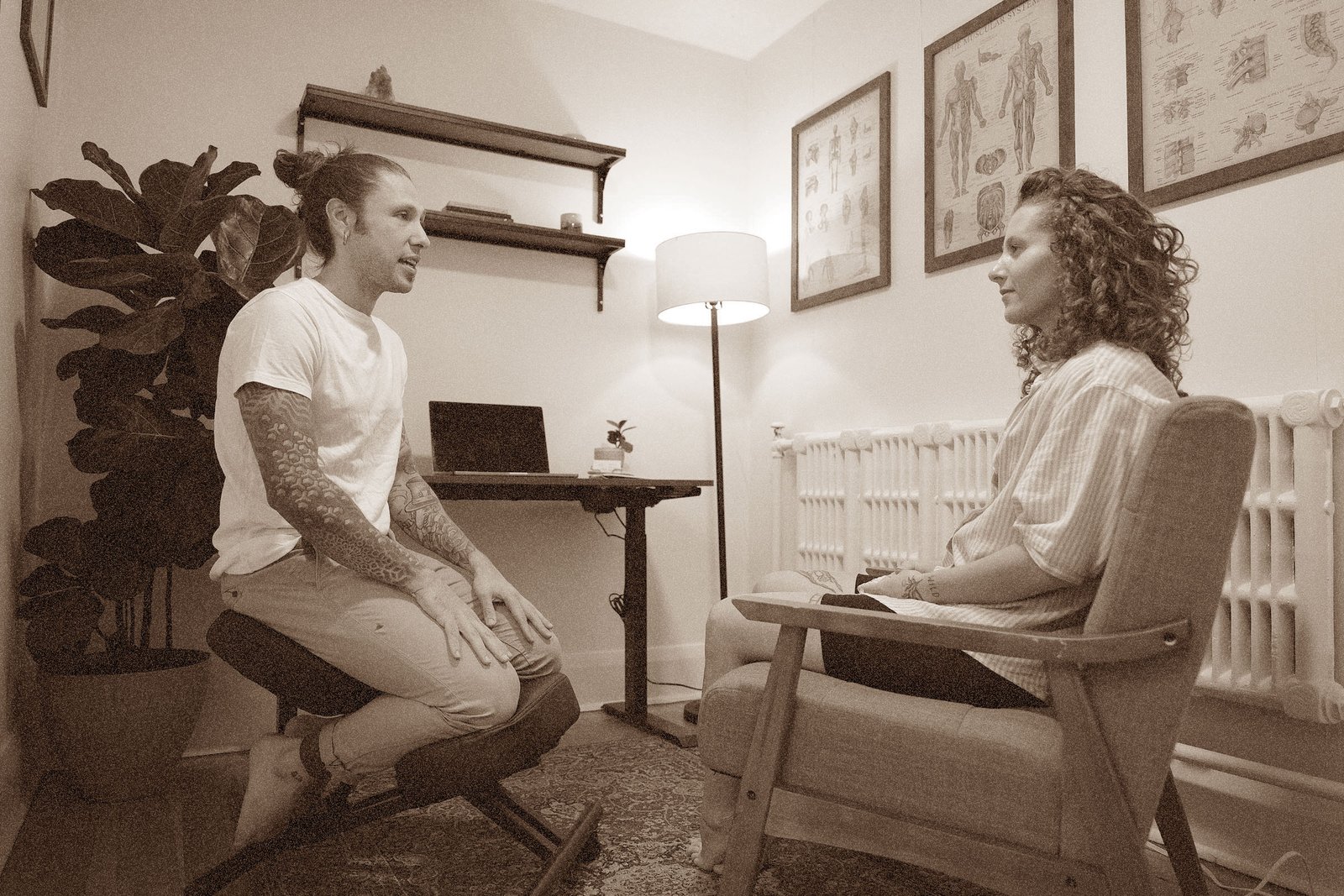
We’ll start by talking. I want to understand your pain: when it started, what helps, what makes it worse, what you’ve tried, what your daily life looks like. I’ll ask about injuries, surgeries, and medical history.
Then I’ll look at your posture and movement. I’ll ask you to stand, walk, and do a few simple movements. This isn’t a test. I’m just reading how your body is organized right now.
The hands-on work
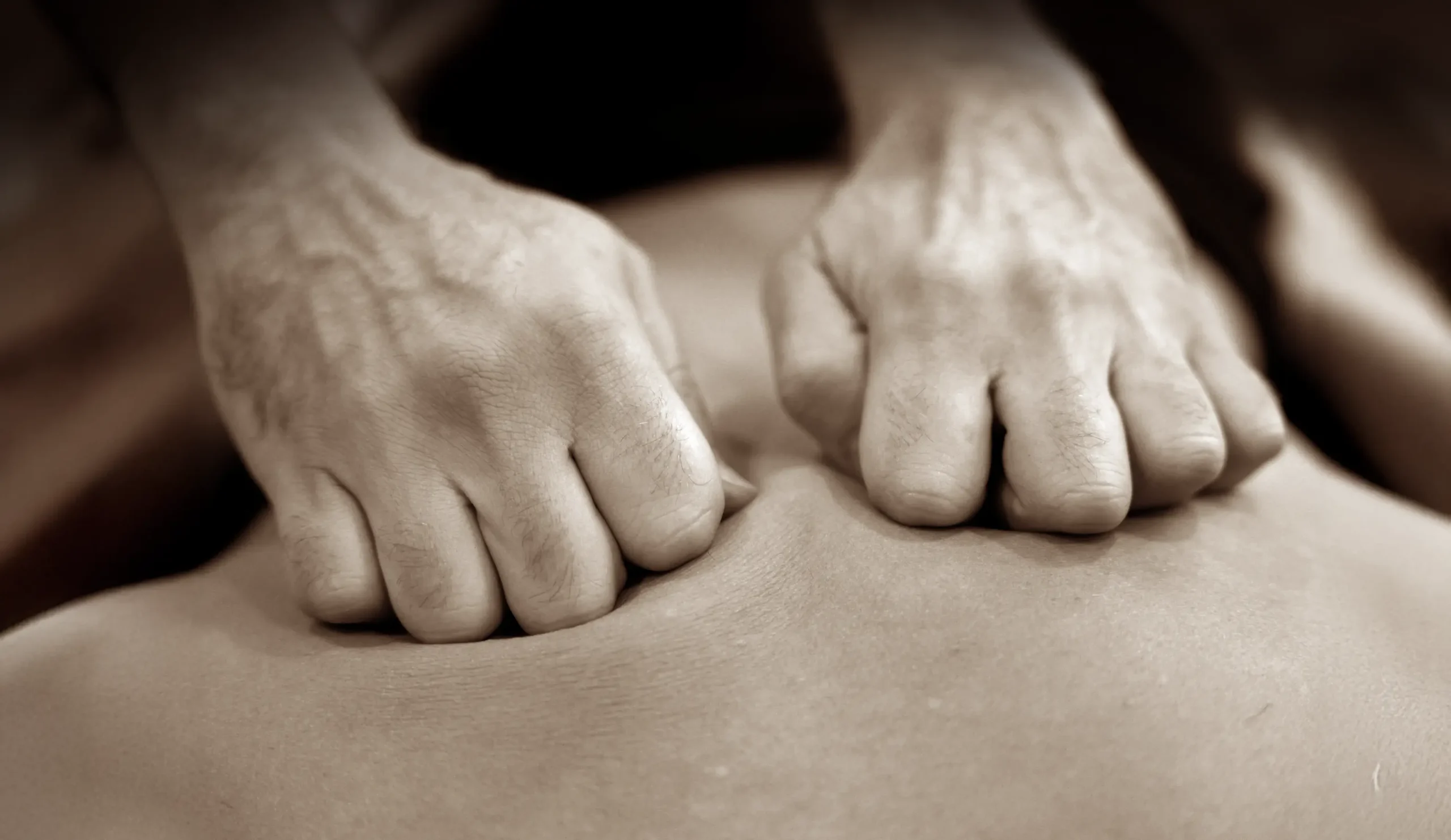
You’ll lie on a treatment table, and at various points you might sit or stand. I use my hands, fingers, and forearms to work with the fascial tissue. The work is firm but should never exceed your tolerance. I check in regularly and always want you to speak up if the pressure needs adjusting.
For back pain, much of the session may actually focus on areas other than the back: hips, legs, abdomen, ribcage. This surprises people, but the back is often compensating for restrictions elsewhere. Working directly on a painful back without addressing what’s feeding into it gives temporary relief at best.
Sessions are 75 to 90 minutes. Most people feel noticeably different after the first session. Not necessarily pain-free, but something has shifted. The body feels more open, more settled.
Between sessions
Changes continue to develop as the body integrates the work. I may suggest gentle awareness exercises or movement practices. I’ll ask you to pay attention to changes, not just in your back, but in how your whole body feels and moves.
How many sessions
The honest answer: it depends.
For chronic back pain, I usually recommend the full Ten Series. The systematic, progressive nature of the series works well for the multi-layered patterns behind chronic pain. Each session builds on the previous one, creating cumulative change that isolated sessions often can’t achieve.
The Ten Series typically unfolds over three to five months, sessions spaced one to two weeks apart. Most clients with chronic back pain start noticing real improvement by sessions three or four, with continued progress throughout.
Some people prefer to start with a few individual sessions before committing to the full series. That’s fine. Even one session gives you a sense of how your body responds and helps you decide whether to continue. After completing the series, many clients find their pain has reduced significantly or resolved. Some come back every few months for tune-up sessions. Others find the structural changes hold on their own, particularly if they stay reasonably active.
What clients actually experience
Without making guarantees, I can describe what I consistently see with back pain clients.
Most experience a real reduction in pain intensity and frequency. Some become pain-free. Others move from debilitating pain to manageable, occasional discomfort. Movements that were painful or restricted (bending, twisting, sitting for long stretches) typically get easier. People report that good posture starts feeling natural rather than effortful. Family and friends notice the change before they do, sometimes.
Many clients find they need fewer chiropractic visits, less massage, or fewer pain medications. They develop a better sense of what their body needs and catch themselves before falling back into old patterns. And the thing that matters most: they can play with their kids again, exercise without bracing for pain, sit through a movie, sleep through the night. That’s what I’m actually measuring success by.
For more about what Rolfing addresses, visit our FAQ page.
Is Rolfing right for your back pain?
Rolfing tends to work best for back pain that has been around for months or years, hasn’t fully responded to other treatments, seems connected to postural issues or body asymmetry, gets temporarily better with treatment but keeps returning, or worsens with prolonged sitting, standing, or specific activities. It’s particularly suited to pain that doesn’t have a clear single-structure cause like a fresh disc herniation needing surgery.
Rolfing probably isn’t the best first step for acute injuries in the first few days (see a doctor), pain from serious pathology like tumors, infections, or fractures (these need medical evaluation), or conditions requiring surgery.
If you’re unsure whether Rolfing makes sense for your situation, I’m happy to talk it through. You can learn more about my background on the about page.
A different way to think about your back
Chronic back pain can make you feel like your body is broken. The thing I find myself saying most often to new clients is: your body isn’t broken. It’s adapted. It organized itself around compensations and restrictions that made sense at some point but are now causing problems.
Rolfing doesn’t fix a broken body. It helps an adapted body find better organization, more balance, less strain. I’ve watched this happen hundreds of times now, and it still strikes me when someone stands up after a session and says, “I forgot my body could feel like this.”
Ready to address your back pain?
If chronic back pain has been running your life and other treatments haven’t given you lasting results, Rolfing Structural Integration is worth considering. At Unify Rolfing, 272 Roncesvalles Ave in Toronto, I work with each client’s unique structural patterns to get at the root causes of pain, not just the symptoms.
Sessions are $180+HST. Book your first session or call 647-581-7018 to talk about your situation. Visit our sessions page for details on the Ten Series.