Trying something new with your body can be nerve-wracking. If you’ve been reading about Rolfing Structural Integration and you’re ready to book, or you’ve already booked and want to know what you’re walking into, this post covers the whole experience from start to finish.
I’m Tomer, a Certified Rolfer at Unify Rolfing in Toronto. I’ve worked with hundreds of first-timers at this point, and the thing I hear most afterward is some version of “that was nothing like what I expected.” Usually said with a smile. So here’s what actually happens.
How to prepare
Preparation is simple. There’s no elaborate pre-visit routine.
Wear something comfortable that you can move in. I need to see how your body moves and get to the areas we’re working on, so most clients wear shorts and a sports bra (for women) or just shorts (for men). Underwear works too. Rolfing doesn’t use oils or lotions, so your clothes won’t get greasy.
Eat a light meal an hour or two beforehand. You don’t want to show up starving or stuffed. Drink water normally throughout the day. There’s no need to over-hydrate, but being reasonably hydrated does help your tissues respond better.
Your first session runs about 105 minutes (the extra time is for the intake conversation and assessment). Plan to arrive a few minutes early. If you’re driving, there’s street parking along Roncesvalles Avenue and on the surrounding residential streets. By transit, the 504 King streetcar stops right on Roncesvalles, and Dundas West station is a short walk away.
The studio: 272 Roncesvalles Ave
The studio is at 272 Roncesvalles Ave, in Toronto’s Roncesvalles Village. I picked this neighbourhood on purpose. It’s walkable, calm, and surrounded by indie coffee shops, bakeries, and the kind of local spots that make Roncy feel like its own small town.
Inside, the space is quiet and clean. It’s not a spa with ambient music and essential oil diffusers, and it’s not a sterile medical office either. It’s a workspace, and the attention is on you and your body.
The intake conversation
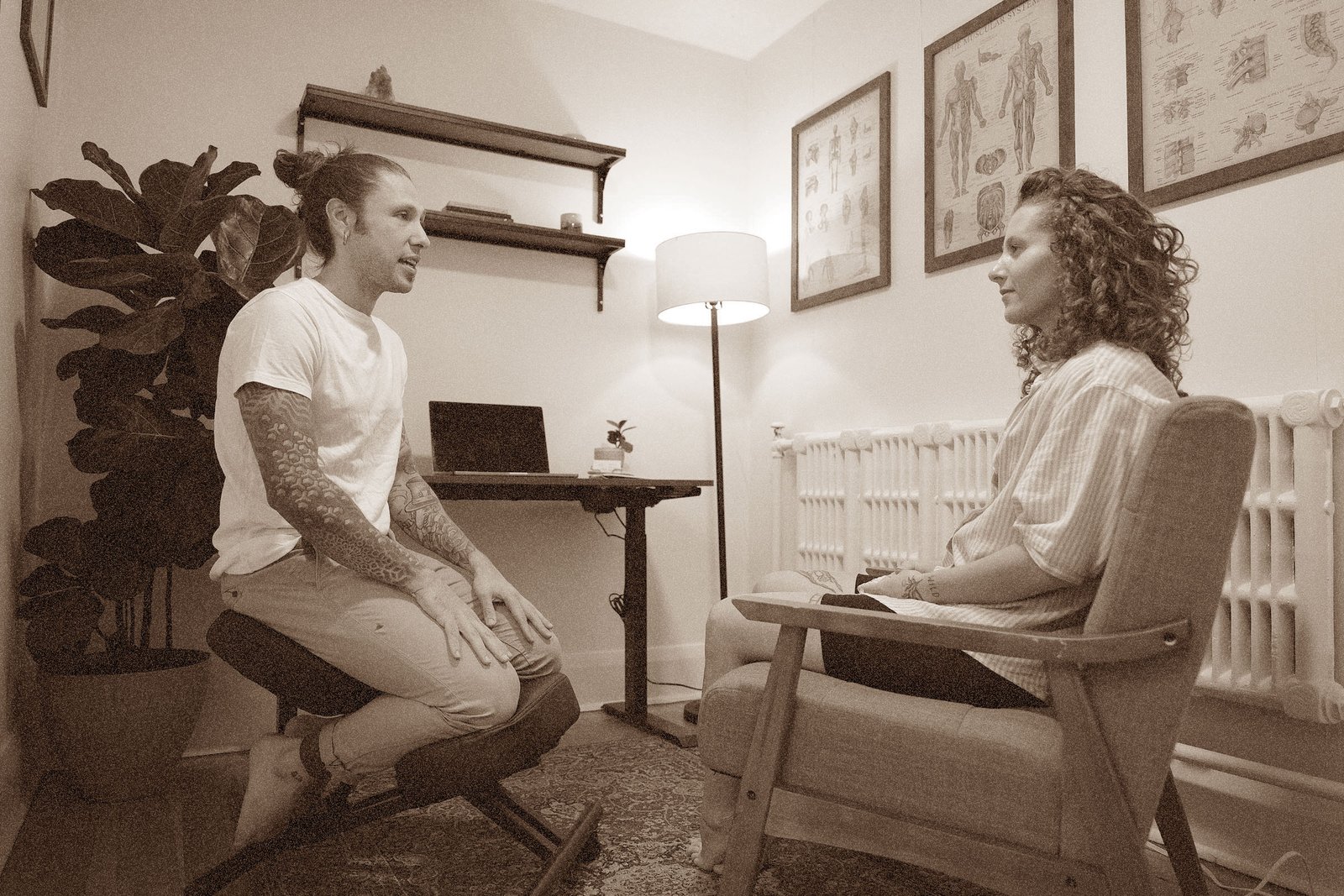
Before any hands-on work, we sit down and talk. This is one of the things that separates Rolfing from most other bodywork, and I think it matters a lot.
I’ll ask what brought you here, whether that’s chronic pain, postural concerns, athletic performance, injury recovery, or just curiosity. I’ll want to know about your history: past injuries, surgeries, repetitive activities, sports, what your days look like physically (desk work, manual labour, chasing kids around). I’ll ask what a good outcome would look like for you. And I’ll want to know about any previous bodywork you’ve had, whether massage, physiotherapy, chiropractic, or something else.
This part usually takes 10 to 15 minutes. It helps me understand the context around your symptoms, not just the symptoms themselves. A sore lower back in someone who sits at a desk for eight hours is a very different structural situation than the same complaint in a marathon runner.
Be honest and thorough. That old ankle sprain from fifteen years ago? It might be directly connected to what’s happening in your hip today. The body is very good at compensating, and understanding your full history helps me see the bigger picture.
If you want to learn more about why Rolfing takes this whole body approach, I’ve written about it on the Why Rolfing page.
The assessment
After our conversation, I’ll ask you to stand and walk so I can observe your structure and movement patterns.
I’m looking at how your weight distributes through your feet, the alignment of your joints (ankles, knees, hips, shoulders, head), curvature patterns in your spine, rotational tendencies like a forward shoulder or a shifted ribcage, and how you walk. Gait tells me an enormous amount about where restrictions live in your body.
This isn’t about judging your posture or telling you you’re doing something wrong. Every body has adapted to its own history of movement, injury, habit, and emotion. The assessment helps me understand how your body has organized itself around those experiences, and where there’s room for more balance.
Some clients feel self-conscious during this part. That’s completely normal. I do these assessments many times a day, and I’m looking at structural patterns, not aesthetics. Most people relax quickly once they see that the process is matter-of-fact.
What Rolfing actually feels like
This is the part most people are curious about, and sometimes anxious about. Rolfing has an outdated reputation for being painful. Let me clear that up.
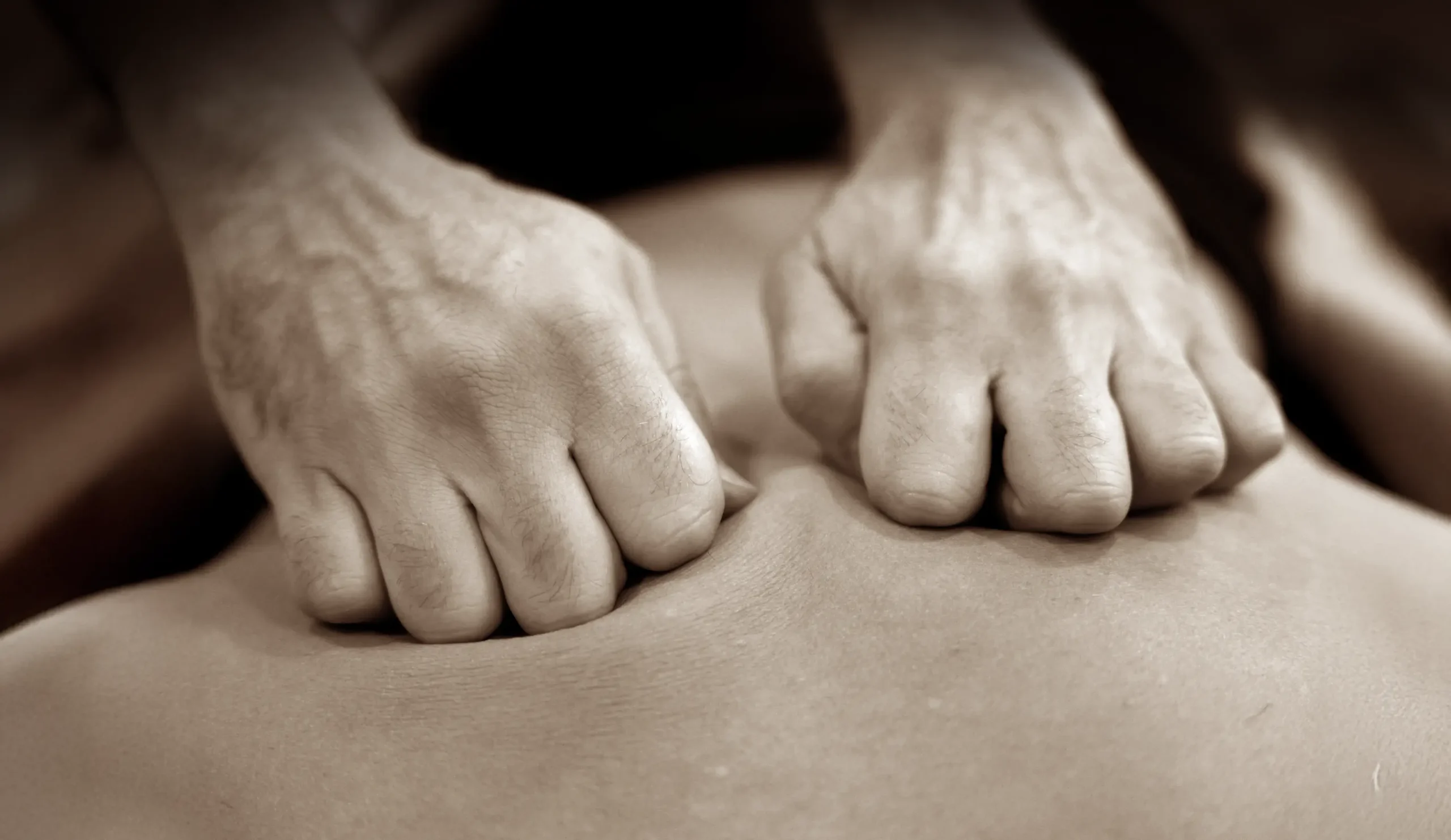
Rolfing works primarily with your fascia, the connective tissue that surrounds and connects every muscle, bone, organ, and nerve in your body. Using my hands, knuckles, and sometimes forearms, I apply slow, deliberate pressure to areas where fascial restrictions are limiting your movement or creating strain.
The pace is different from massage. Where massage often uses flowing, rhythmic strokes, Rolfing is slower and more specific. I’m engaging with a particular layer of tissue, waiting for it to respond, and then following that response. It’s more like a conversation with your body than a one-directional treatment.
The sensation varies from moment to moment and person to person. Most of the work feels like firm, sustained pressure, similar to deep tissue massage but slower and more targeted. Some areas may feel intense, especially where tissue is very restricted. Clients often describe this as a “good hurt,” like stretching a tight muscle. Other areas feel surprisingly subtle, almost gentle, even though significant change is happening in the tissue. You might feel warmth, tingling, or a sense of release as tissue lets go of long-held tension.
Here’s what matters: you are always in control. If something is too intense, tell me, and I adjust immediately. Effective Rolfing does not require you to grit your teeth. I work within your body’s tolerance because that’s where the best and most lasting change happens. If your nervous system is bracing against the pressure, the tissue can’t release properly.
I also incorporate movement during the session. I might ask you to breathe deeply, make a small movement with your arm or leg, or shift your weight while I’m working on an area. This active participation helps your nervous system integrate the changes in real time.
In a first session, I typically work with the superficial fascial layers, the outer “sleeve” of the body. This often includes the ribcage, breathing structures, hips, and legs. I tailor every session to what I’m seeing, so there’s no rigid formula. The goal of the first session is usually to create more space and ease in your breathing and to start addressing the most prominent patterns from the assessment.
If you’re curious about how sessions progress over time, the Sessions page explains the different approaches, including the Rolfing Ten Series.
How long and how much
A standard session is 75 minutes of hands-on work. Your first session will run closer to 90 minutes total because of the intake and assessment. Subsequent sessions are typically 75 minutes. Some clients opt for shorter tune-up sessions once we’ve completed an initial series.
Sessions are $180 + HST. Full details on the Sessions page.
After your session
When you get off the table, I’ll have you stand and walk again. Most people notice something different right away, a sense of being taller, more grounded, or lighter on their feet. Sometimes the change is dramatic, sometimes it’s subtle. Both are normal.
In the first 24 to 48 hours, you might experience a feeling of openness in areas that were tight, or a new awareness of your posture and movement (you might catch yourself sitting differently without trying). Some mild soreness is common, similar to what you’d feel after a good workout, especially in areas where we did deeper work. This usually resolves within a day or two. Some people feel a surge of energy, others want to rest. Emotional shifts can happen too. Some people feel calmer or more present, and occasionally old emotions surface. This is a normal part of releasing long-held tension patterns.
After your session, go for a walk. Fifteen to twenty minutes helps your body integrate the structural changes, and Roncesvalles is a good neighbourhood for it. Head south toward the lake or wander through High Park. Drink water normally. Skip the heavy workout for the rest of the day (light movement is fine, a heavy deadlift session is not). And pay attention to what feels different. The changes from Rolfing often reveal themselves gradually over the following days.
Getting the most out of it
After working with clients across Toronto for years, a few things consistently make a difference.
Talk to me during the session. If the pressure is too much, say so. If you notice an interesting sensation somewhere else in your body, mention it. If something feels great, that’s useful information too. Rolfing works best as a collaborative process.
Be patient. Rolfing creates structural change, and structural change takes time to fully integrate. Some benefits are immediate, others unfold over days and weeks. Your body has spent years or decades organizing itself in certain patterns, and unwinding those patterns takes time.
Keep moving between sessions. Rolfing doesn’t ask you to do a prescribed set of exercises (though I may suggest simple movement explorations). Walk, stretch, do your regular activities. Your body integrates Rolfing best when it’s in motion.
Consider doing a series. While a single session can be helpful, Rolfing is designed as a series. Most commonly the Ten Series, a structured sequence that systematically addresses your entire body. Many of the deepest and most lasting changes I see happen when clients commit to the process over multiple sessions. That said, there’s no pressure. We can talk about what makes sense for your goals.
And come with curiosity. The clients who get the most out of Rolfing tend to be interested in their bodies. They notice shifts, ask questions, and engage with the process. You don’t need any anatomy knowledge, just a willingness to pay attention.
Common questions
For a full list, visit the FAQ page. Here are the ones I hear most from first-time clients.
“Will it hurt?” It shouldn’t be painful. Certain moments may be intense, especially in restricted areas, but intensity and pain are different things. You’re always in control, and I adjust based on your feedback.
“How is this different from massage?” Massage primarily works with muscles to relieve tension and promote relaxation. Rolfing works with fascia to change structural patterns. The goals, techniques, pace, and outcomes are different. A lot of my clients also get regular massage. The two complement each other well.
“How many sessions will I need?” It depends on your goals. Some people come for a single session to address a specific issue. Others do the full Ten Series for comprehensive structural change. We’ll talk about what makes sense after your first session, when I have a clearer picture of what your body needs.
“Is Rolfing covered by insurance?” Many extended health plans in Ontario cover Rolfing under registered massage therapy or other manual therapy categories. Check with your provider. I can give you receipts for your records.
Book your first session
If you’ve read this far, you’re probably ready. You can reach me directly to schedule.
I’m at 272 Roncesvalles Ave, Toronto, in Roncesvalles Village. Call or text me at 647-581-7018, or use the contact page.
Your body has a story. I’d like to help you understand it, and help it find a better way to move.